
Joachim Heintz
Composer · Educator · Writer
A leading voice in electroacoustic and intercultural contemporary music, Joachim Heintz creates sonic narratives that awaken associations without confining the imagination to a fixed time or place.
Joachim Heintz stands among the defining voices at the intersection of electroacoustic composition, open-source technology, and cross-cultural musical collaboration. Over three decades, he has built an authoritative body of work that spans instrumental composition, live electronics, sound installation, and software instrument design, while simultaneously shaping the institutions that sustain contemporary music practice—as longtime director of the FMSBW electronic studio at the Hanover University of Music, Drama and Media, as former head of both the German Society for Electroacoustic Music and the Hanover Society for Contemporary Music, and as an early, influential architect of the Csound open-source community. His aesthetic signature is unmistakable: a rigorous, reflective approach to sound that treats composition as an ethical encounter with the unfamiliar, whether that unfamiliarity arrives through inherited material, foreign musical traditions, or the act of collaborative improvisation itself. Few composers of his generation have pursued intercultural exchange with such sustained depth and institutional consequence, positioning Heintz as a pioneering figure in the global dialogue between contemporary Western composition and the musical traditions of Asia and Latin America.
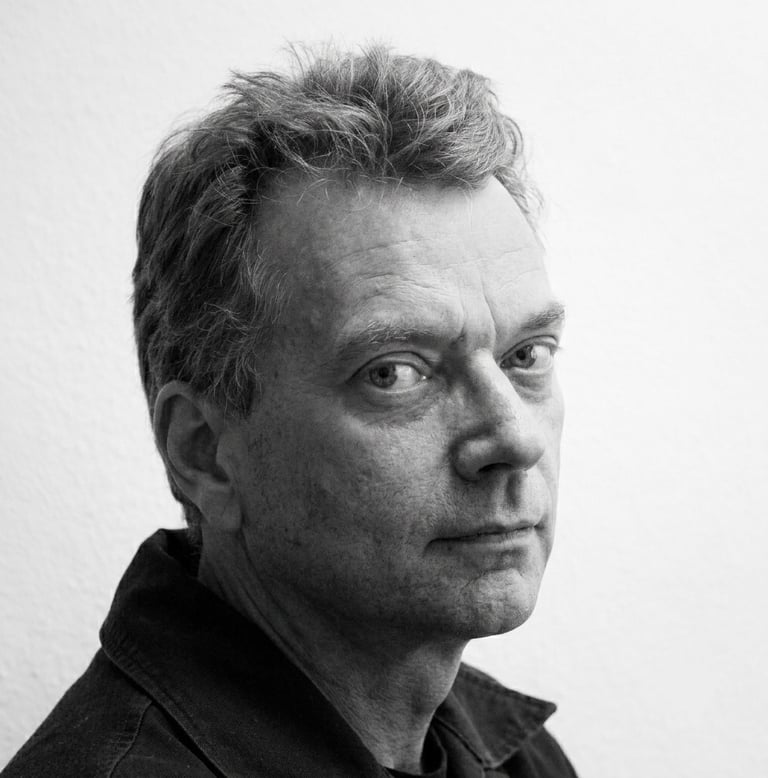
Heintz was born in Braunschweig in 1961, in a household where music arrived not through the ceremony of the concert hall but through the intimacy of a speaker in the family living room. Hearing Beethoven on his mother's vinyl records at the age of ten produced something closer to revelation than mere appreciation—an experience felt at home, paradoxically, rather than at a remove. That early encounter with music mediated by technology would resurface decades later in his electronic studio practice, where he again stands before speakers, pursuing something immediate and unguarded rather than distant and ceremonial. Piano lessons followed as a matter of family tradition, but it was popular music—the Beatles, then Pink Floyd—that first drew him toward composing, followed by a formative period in a school jazz-rock band that introduced him to improvisation and, through it, to the wider terrain of contemporary music. Composing, however, felt too consequential to be formally studied at first. Heintz turned instead to literature and art history, eventually settling in Hamburg to study with Klaus Briegleb, engaging seriously with Heine, Peter Weiss, Bachmann, Heiner Müller, and Lessing, and confronting the weight of the Shoah through rigorous historical and textual inquiry. He spent the years that followed teaching piano privately while continuing to write, before recognizing that composition, which had never truly ceased, demanded a proper framework. In 1995 he entered the Hochschule für Künste Bremen, where his study with Younghi Pagh-Paan proved formative precisely because it resisted easy comprehension. Working alongside Günter Steinke and absorbing the music of Xenakis, Nono, Lachenmann, and Klaus Huber, he established the technical and aesthetic foundation for a compositional voice defined by both discipline and openness to discovery.
Writing has remained, for Heintz, the essential counterpart to composing rather than a separate pursuit. Many of his essays engage directly with musical questions—reflections on electronic music in Iran, on teaching and learning electronic music, and on the path from lifting a turtle to writing code—while others take the form of open-ended contemplation, as seen in his shorter reflective texts. Taken together, these writings function less as commentary on his music than as its other half: a parallel practice of thought that runs alongside, and often clarifies, what his compositions leave unsaid.
It was in the mid-1990s that Heintz encountered the computer—first through PatchWork and Max, then Lisp and Csound—and its impact on his practice was immediate and enduring. Early electronic works such as Seduction and Ein Ort für Zufälle explored virtual event structures and chance operations within fixed systems. Csound, the oldest surviving audio programming language, would later become central to his life — but primarily as a social and collaborative activity, distinct from the more personal path his composing has followed, a path with no fixed destination, always in movement. Active in the open-source world since 2005 and an editor of the Csound FLOSS Manual since 2010, Heintz treats this work not as peripheral technical service but as a political and social conviction in its own right: that software, like knowledge, should not remain the exclusive property of those with institutional access or resources, but should be shared, collectively developed, and open to all. Alongside this, his software instrument ALMA, occupies its own space in his practice. Though a side project relative to his broader compositional work, ALMA functions as a shared, improvisatory instrument, one he has used to perform alongside musicians as varied as free-music improvisers Günter Christmann, Elke Schipper, and Michael Griener in reziprok, and vocalist Shaghayegh Bagheri in Seyr und Silence. In each case, ALMA imposes no fixed language on the encounter; it opens a space where structure and spontaneity can meet, somehow mirroring — without claiming to embody — the same instinct for dialogue and non-hierarchy that runs through his open-source advocacy.
That same fascination with the foreign—with materials, cultures, and sounds originating outside oneself—runs through the whole of Heintz's output, and it has taken him across an unusually broad geography. Through the Hanover Society for Contemporary Music, which he directed from 2014 to 2024, and later through the association multiphon, he organized the TRAIECT series, staging direct encounters between contemporary composition and the musical traditions of Vietnam, Taiwan, Iran, and Korea, work that has since extended to recent engagements in Uruguay. His multi-year collaboration with Korean Pansori singer Soohyun Moon, spanning Salz, PP ㅂㅍ, and ... birgt die Trauer aller Zeiten ..., exemplifies this approach: the vocal extremity of Pansori is not absorbed into a Western electronic frame but treated as a foreign presence around which the electronics are built in deference. Nowhere is this principle more explicit than in Fremdeigentum ("Third-party property"), a 2020 electronic work assembled entirely from pre-existing material that Heintz collected and transformed rather than composed from nothing. Structured in three movements—nach-richten, be-greifen, and b_b—the piece constructs an experiential space for the listener, confronting them with sound that was, quite literally, authored by someone else before being reshaped into his own. A related interrogation of foreignness appears in Ein Seeteufel, his live-electronics setting for a reading by Yoko Tawada, where the electronic layer must accommodate a text and voice never fully within his control, and again in Wege, his reworking of Mozart for string quartet and electronics, in which historical material is entered into rather than simply quoted.
Underlying this expansive body of work is a philosophy Heintz has articulated with rare precision: that music is bound to deep feeling paired with conscious reflection, one never sufficient without the other. He requires an enclosed, protected space to compose—a deliberate disconnection from the external world that allows musical material to develop, in his own words, "by itself," gathering its own momentum rather than being forced into shape. Installations such as Potentiale, distributed across sixteen speakers, and Gläserne Unterbrechung, conceived for a specific gallery environment, extend this principle spatially, generating enclosed environments within which sound unfolds on its own terms. Heintz's ambition is for this self-happening quality to transfer directly to the listener, so that the enclosed space he constructs in the studio becomes, in performance, an enclosed space for the audience as well—one in which music is experienced as something occurring to them, rather than something merely delivered. This conviction has shaped not only his compositions but his sustained institutional leadership, underscoring his standing as one of contemporary music's most rigorous and far-reaching practitioners.
Selected Works
Collaborators & Ensembles
Joachim Heintz's artistic partnerships are best understood not as a sequence of commissions, but as sustained forms of cultural engagement and shared musical thought, often unfolding across years and multiple works. His collaboration with Pansori vocalist Soohyun Moon has evolved across Salz, PP ㅂㅍ, and ... birgt die Trauer aller Zeiten ..., forming a body of work grounded in deep familiarity with the tradition rather than surface encounter. Similarly enduring exchanges shape his writing for oud with Yasamin Shahhosseini (Y, Alma) and for voice with Shaghayegh Bagheri (Seyr und Silence), and for santur with Mehrnoosh Zolfaghari (memori), while his work with the Nomos Quartett (Wege), Ensemble Musikfabrik (Anti II), and Margit Kern (Schlagschatten) reflects an equally serious commitment to the contemporary instrumental repertoire. His improvisatory collaborations with Günter Christmann, Elke Schipper, and Michael Griener in reziprok, together with his live-electronics response to a reading by Yoko Tawada in Ein Seeteufel, further reveal a composer whose partnerships are defined by depth of encounter, reciprocity, and artistic attentiveness.
Positions & Affiliations
Head of the FMSBW electronic studio, Hanover University of Music, Drama and Media (since 2004)
Director of Electronic Department, Yarava Music Group (since 2017)
Head of the multiphon association, Hanover (since 2023)
Editor and author, Csound FLOSS Manual (since 2010)
Former director, Hanover Society for Contemporary Music (2014-2024)
Former head, German Society for Electroacoustic Music (2012-2016)
Guest professor, ICEM, Folkwang University of the Arts, Essen (2016-2017)
Active contributor, Open-Source Movement (since 2005)